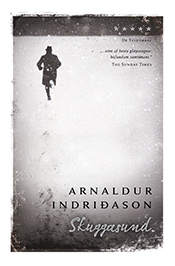
An old man is found dead in his apartment in Reykjavik. On his desk are newspaper clippings going back to the Second World War about a brutal murder: a girl was found strangled behind the National Theater which, at the time, was a storage facility for the American Army. A retired police officer hears about the incident and his curiosity awakens. He remembers the case of the dead girl but wants to find out why the old man kept news related to her murder. In
“The language is clear and concise, but at the same time richly expressive and deep... Every detail is carefully thought through, and the plot is masterfully crafted, delicate and precise as clockwork.” From the verdict of the jury of the RBA International Crime Novel Award
FIVE STARS OUT OF FIVE “The best has never been better Arnaldur Indridason is one of the world’s top thriller writers, and his latest book Skuggasund is quite simply terrific on all levels. The author’s virtuosity shines through every single page of this amazing work. For this book, Indridason recently won the 2013 RBA International Prize for Crime Writing; this highly prestigious prize, worth €125,000, is awarded annually in Spain for novels in pre-publication, which are submitted under noms de plume. Speaking about the prize in an interview with the newspaper Morgunbladid, Indridason said, “I look upon this award above all as a literary recognition. It’s a recognition of Icelandic crime fiction and Icelandic literature in general, and of what Icelandic writers are concentrating on.” There is no need to reinvent the wheel. Indridason’s reaction to the award speaks volumes about The Shadow District and its author, and this critic is in complete agreement with him. He has forged a new path and attained a previously unknown level of achievement. It has been especially enjoyable to follow Arnaldur Indridason’s development as a writer over the years. Having put the detective Erlendur Sveinsson to rest, for the time being at least, in the superb Strange Shores, and given us the prequel to our friend’s career in Reykjavik Nights – another outstanding novel – he has now turned to other characters in other times. In The Shadow District he excels himself. In this book Indridason focuses on the Reykjavík of 1944, linking an unsolved murder from that time to the recent death of an elderly man. He captures you right from the first page, keeping you enthralled to the very end. His characters, both present-day and wartime, spring vividly to life, and his descriptions of places cast light on one world that is hidden from many, and another that the reader would benefit from becoming better acquainted with. Indridason’s brilliant narrative technique is at its best here; making a connection with Manitoba through one of the book’s central characters is a great idea, a clever way of emphasizing the important relationship with our Western friends in Canada. This is one of Indridason’s best books ever, and if anybody deserves a standing ovation it is Arnaldur Indridason for The Shadow District.” Steinthor Gudbjartsson, Morgunbladid daily
“In this book Arnaldur Indridason offers us a two-level investigation into crimes which the reader knows instinctively must be connected. But it is not just the plot that grips us, as Indridason uses his customary storytelling brilliance to create his characters, steeping us in the scary daily lives of the ordinary people who become part of the investigation … Sit down in your favourite armchair in a suitably quiet atmosphere, with or without music, open the well-translated pages of The Shadow District, and prepare for non-stop enjoyment without rivers of blood, serial killers or disorderly mental patients. The book inspires pleasure with its concise text, its reflective descriptions, and the reader’s sympathy with a writer who manages to kindle interest in the whole country while only writing about his immediate surroundings.” Paco Camarassa, El Mundo, Spain
“Indridason’s fans, unhappy that Erlendur, eater of sheep’s heads, has left the stage, can rejoice in the fact that they now have The Shadow District to read. Step forward Konráð, a brand new police officer, albeit a retired one, whom it looks as if readers will be getting to know better in books to come. He also has a difficult childhood behind him, as well as some adventures hinted at but not explained further. We wait with bated breath. There are, actually, three policemen in the spotlight, as we have two stories here; a murder in 1944 as well as one in the present time, and Flóvent and Thorson, who investigated the earlier killing, are also well-crafted and interesting characters whom, alas, we shan’t be getting to know better. And yet, who knows? Indridason’s hallmark as a crime writer is his fondness for his characters; investigators and victims alike spring into life in the reader’s mind, as do criminals and suspects. The Shadow District is no exception in this respect, and despite the hideousness of their crimes, the perpetrators are drawn with a sense of humanity that makes it impossible for readers to hate them—all except for one. The central mystery of the investigation is the murder in 1944, and it transpires that the present-day murder is directly linked to it. Indridason describes the atmosphere of the age and the conditions of life extremely well, and by making one of the investigators a Canadian ‘West-Icelander’ who is not too familiar with local conditions, he manages to sneak in all manner of reflections on hot topics from 1944 in the form of conversation between him and Flóvent, without this becoming forced or disruptive to the narrative. The whole development of events is believable, too, in contrast with what often happens in crime novels, and the reader becomes deeply involved in the investigations as never before. The identity of the murderer is almost irrelevant, it is the lives of the people involved in the story that create the interest and excitement. The construction of the story is extremely professionally crafted. The two period settings flow effortlessly into one another, and the way they are knit together is faultless. The style is vintage Indridason, no flourish or affectation, and the dialogues are more carefully crafted than often before—there is no hint of literary language or pretence, and you believe every word. The Shadow District does not mark a watershed in Indridason’s career, it represents a continuation of the development of his style and construction we have seen in recent years, and is a well-crafted and carefully thought out story which moves the reader on many levels and raises in his or her mind the perennial question whether we really have made positive progress during the years Iceland has been a republic. Conclusion: A well-crafted and carefully thought out story in two time periods. The mise-en-scène, characterisation and construction combine to make The Shadow District one of Indridason’s best books.” Fridrika Benonysdottir, Frettabladid daily
FOUR STARS “Extremely strong Indridason. I don’t need to go into detail here about Arnaldur Indridason’s strength as a crime writer and the care and professionalism with which he tells his stories … Indridason has a unique style which absolutely works … this is a masterpiece. It is his best book by far in many years, and I cannot remember having enjoyed reading him as much as I did this book. Indridason has long since conquered Iceland and a large part of the rest of the world with his stories about Detective Erlendur Sveinsson and his satellites Sigurdur Oli and Elinborg. Indridason put Erlendur to rest a while ago, and there are many who long for news of that much-admired detective’s fate. But, judging by the enormous energy Indridason displays in The Shadow District, one is tempted to think that he is enjoying the freedom he has gained by leaving Erlendur out on the moors.
… Indridason tells the story of The Shadow District in two time periods. A body found in Reykjavík in 1944 during the Allied occupation sets in motion a chain of events which stretch into the present day, where Konrad, a retired policeman, is helping a former colleague with an investigation into the mysterious death of a ninety-year-old. It seems to be connected with the death of a young woman in 1944, and characters are linked together in various ways between the two periods. Thus, Indridason knits together the two stories in an elegant and entertaining way, infusing the narrative with a great deal of emotional momentum. He weaves various minor tragedies into the narrative, and rouses interest, curiosity and sympathy throughout. Indridason’s sophisticated use of language fits perfectly with the 1944 zeitgeist, and when in this mode, he recreates such a vivid reflection of the age that reading about it is pure joy. He masters the art of combining two different eras perfectly, and displays all his best facets in a book that is surely one of his very best works.” Thorarinn Thorarinsson, Frettatiminn weekly
Kolbrun Bergthorsdottir, Kiljan National TV
Sigurdur G. Tomasson, Kiljan National TV
Helga Birgisdottir, Spassian
Bjorgvin G. Sigurdsson, Pressan